Marketing analysis
Analysis of Crunchyroll’s social media: successes and failures
A two-week review of Crunchyroll’s activity on Facebook, Instagram and Twitter, compared with its main competitor, FUNimation.

Overview
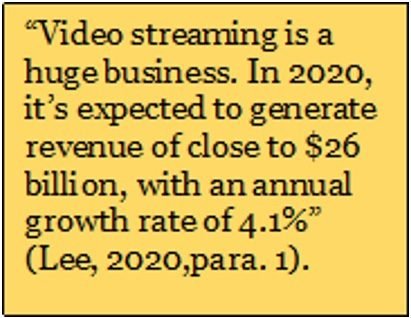
This paper analyzes the social media activity of the company, Crunchyroll, over a two-week period from September 2nd until September 16th. Crunchyroll is a streaming company for watching Japanese animation. In this paper, the word “anime” will be used to describe the niche market of Japanese animation; this is not to be confused with any other type of cartoon or CGI animation. This paper intends to analyze Crunchyroll’s marketing and social media presence across three platforms, Facebook, Instagram, and Twitter. This paper will compare this data with Crunchyroll’s main competitor, FUNimation. Finally, discussing and critiquing the key findings and differences found in this paper, we will determine whether Crunchyroll needs to do better in its marketing to stay on top of competitors, or if it is doing better than its competition.
Research
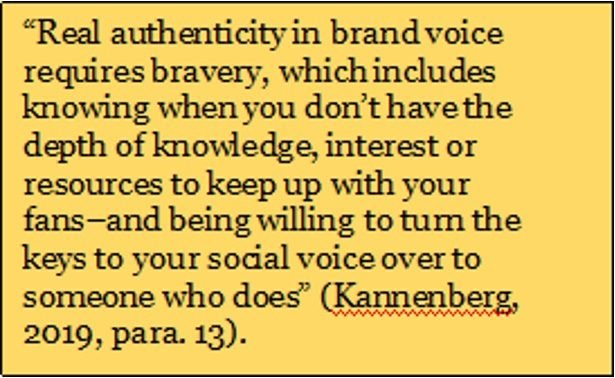
Streaming companies should know their audiences when posting on social media, choosing language and mannerisms carefully to “highlight your devotion without sounding like an infomercial” (Sima, 2016, para. 25). It is also important for companies to acknowledge their customers and actively participate in discussions on social media (Sima, 2016, para. 17). Sima (2016) also states that streaming companies must “pay attention to Twitter and make sure everyone else knows you do – all those hashtags and @handles can be a well of information that brands can use to boost their customer care efforts and, in turn, increase brand loyalty” (para. 11).
Ramakrishnan (2019) writes three takeaways from her analysis on Netflix’s successful social media strategy. These takeaways were that a streaming company must give customers what they want, such as a movie suggestion, or shows to watch (para. 21). As well, a streaming company must post consistently, and build customer relationships over social media (Ramakrishnan, 2019, para. 22–23). It is important for a company to develop an online persona or personality to stand out and be memorable.
About Crunchyroll’s Brand
Crunchyroll is one of the leading international streaming platforms for Japanese anime and manga. Crunchyroll acquires many high-quality titles and creates their own original content. Crunchyroll’s brand has been geared towards offering specifically “subbed” anime, meaning they use subtitles and do not adapt the original voices. Crunchyroll’s key messages on Twitter and Instagram are consistent; however, their Facebook biography is significantly different. Their social media also use the mascot “Crunchyroll-Hime” to represent themselves.
Crunchyroll’s Social Media Activity
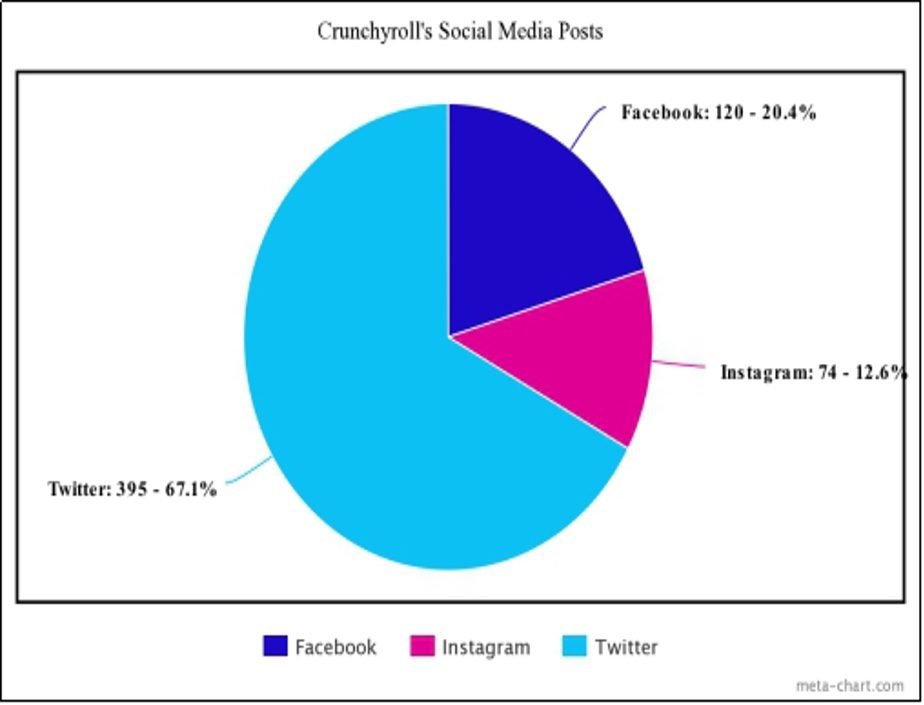
On social media platforms, their online presence is quite strong. As seen in the pie graph above, Crunchyroll posts mainly on Twitter, and the least on Instagram. Facebook is in the middle with 120 posts over the two-week period. This graph shows the total original posts on their accounts’ timelines or main pages; however, it does not include “retweets”, 24 hour “stories,” or “shares”. Their followers on Twitter are 1.4M, Facebook has 3.5M, and Instagram has 2.3M followers. Perhaps their focus on posting mostly to Twitter is to increase the follower numbers where they are lacking.
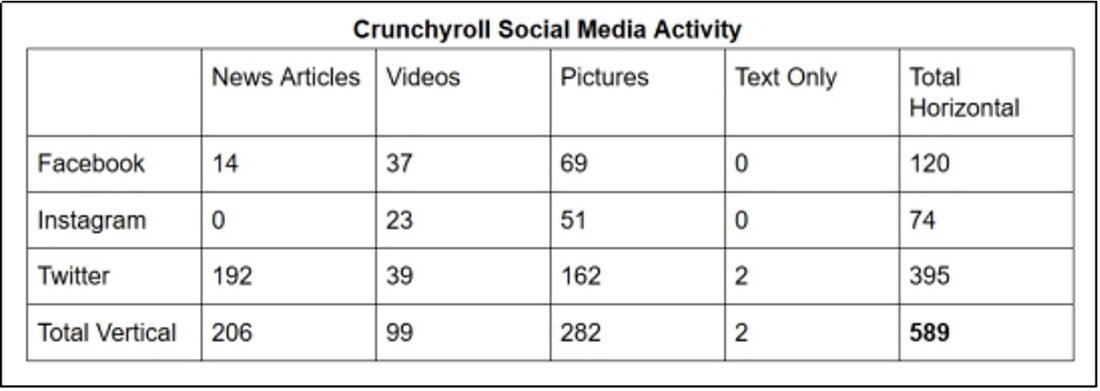
The table above shows what Crunchyroll posted on each social media account. Their focus is overall on pictures to each account. Twitter had a significant amount of anime-related news articles posted. Overall, Crunchyroll posted 589 times on their social media accounts from September 2nd until September 16th.
Crunchyroll’s Consistency and Engagement
Most of the content posted on Crunchyroll’s Facebook account includes pictures and video clips to promote their anime. Their voice on Facebook is an “advertisement voice.” This means they speak to their followers through their posts like an advertiser and have no specific persona. Crunchyroll did not interact with their followers in the comments section. They post roughly 10 times a day.
The Crunchyroll Instagram account updates its posts frequently, but most of the content they share are daily stories that delete automatically after 24 hours. Their account timeline gets posted to roughly 1-5 times a day. Their “stories” get posted to roughly 10 times a day and these include interactive quizzes. On Instagram, Crunchyroll asks their followers more questions with their pictures, creating discussions, however they do not partake in the discussions.
Crunchyroll’s Twitter platform mainly uses news articles and photo sharing. Their only interaction with followers using text posts was to inform viewers of their website having troubles. Their account timeline gets posted to roughly 20 times a day. They use the “advertising voice” on this platform as well, and do not engage with their followers.
Competition Brand Comparison
Crunchyroll’s main competition in anime streaming companies is FUNimation. Although they have second-tier competitors, like Netflix and Hulu, these companies do not focus on anime and did not post any anime related content on their social media.
FUNimation, unlike Crunchyroll, does not create any original content. Overall, FUNimation’s brand is geared towards “dubbed” anime. This means that instead of using English subtitles, they use English voice actors to “dub” over the original language and voice actors. These two genres often split anime fans, and based on the viewers’ favouritism, they are more likely to choose one website over the other. FUNimation does not have a key message over their social media, and their biography pages each differ.
Competition Social Media Activity Comparison
FUNimation posted rather equally across Twitter and Facebook. The numbers of their posts combined are significantly less than Crunchyroll’s total posts. Their followers for Twitter are 1.1M, Instagram has 1.3M, and Facebook has 2.1M followers.
FUNimation posted 291 fewer times than Crunchyroll in the two-week period. They also posted significantly fewer videos across their social media platforms than Crunchyroll. However, out of the two companies, it was the only one to directly ask their followers a question.
Findings and Recommendations
Crunchyroll uses their social media very successfully; however, there are a few areas where they could improve their marketing techniques. When it comes to their brand, they box themselves into a single genre with “subbed” anime. This causes “subbed” and “dubbed” fans to split their choice between competitors for whichever will cater to their preferred genre. However, Crunchyroll comes out on top when it comes to the amount of content available on their website and creating their own content gives them a step up over their competition.
When it comes to their social media activity they certainly rise above their competition with their numbers. They post very frequently and focus their attention on the social media accounts that have the least following. On a positive note, they give frequent suggestions on what to watch, including pictures and videos that highlight the show they are advertising. Another positive is that their key messages remain consistent across social media. However, they could improve in posting more consistently over each social media account. They also lack using hashtags and @handles on their Twitter page. Crunchyroll’s persona across social media is not established and they do not stand out when they post. However, their largest downfall is their lack of interaction with their followers. They do not participate in discussions at all. This can cause their followers to feel a lack of acknowledgment and be detrimental to consumer loyalty. Luckily for them, the online anime community is highly active in discussing amongst themselves.
References
- Business Case Studies. (2019, August 19). 5 social media marketing tips from Netflix. Business Case Studies. Retrieved from https://businesscasestudies.co.uk/5-social-media-marketing-tips-from-netflix/
- Crunchyroll [@crunchyroll]. (n.d.). Posts [Instagram profile]. Retrieved September 2–16, 2020, https://www.instagram.com/crunchyroll/
- Crunchyroll [@Crunchyroll]. (n.d.). Posts [Twitter profile]. Retrieved September 2–16, 2020, from https://twitter.com/Crunchyroll
- Crunchyroll. (n.d.). In Facebook [Facebook page]. Retrieved September 2–16, 2020, from https://www.facebook.com/Crunchyroll
- Funimation [@funimation]. (n.d.). Posts [Instagram profile]. Retrieved September 2–16, 2020, from https://www.instagram.com/funimation/
- Funimation [@FUNimation]. (n.d.). Posts [Twitter profile]. Retrieved September 2–16, 2020, from https://twitter.com/FUNimation
- Funimation. (n.d.). In Facebook [Facebook page]. Retrieved September 2–16, 2020, from https://www.facebook.com/funimation
- Kannenberg, L. (2019, September 19). Social Spotlight: How Netflix uses social to create a brand experience [Blog post]. Sprout Social. Retrieved from https://sproutsocial.com/insights/social-spotlight-netflix/
- Lee, J. (2020, March 24). Streaming Services: Breaking Into a Competitive Market. AdRoll. Retrieved from https://www.adroll.com/blog/marketing/streaming-services-Breaking-into-a-competitive-market (no longer available)
- Ramakrishnan, V. (2019, June 20). How Netflix’s social media strategy dominates the online streaming industry [Blog post]. UnMetric.
- Sima, I. (2016, August 31). A Netflix Story: The Human Approach to Social Media Marketing [Infographic]. Social Media Today. Retrieved from https://www.socialmediatoday.com/marketing/netflix-story-human-approach-social-media-marketing-infographic
First published on my earlier portfolio site on April 4, 2023. Written as a class project during my communication studies.